
The Misunderstood Power of WordPress as an Enterprise Application Framework
Do you remember the tools that promised to change everything? Every year, a new platform appears. It promises that you can build the next Uber or Facebook without writing a single line of code. Investors pour millions of dollars into them. Tech influencers make videos about them. Companies rush to move their data into these new systems because they are afraid of missing out.
Then, a few years pass. The excitement fades. The tool becomes too expensive. Or worse, the company behind the tool shuts down. Google App Maker came and went. Parse was bought and shut down. Countless “drag and drop” app builders have quietly disappeared, taking their customers’ data and hard work with them.
In this chaotic world of trends that pass by, one platform is different. It does not disappear. It does not get sold and shut down. It just keeps growing. For twenty years, it has been the quiet engine behind the internet.
That platform is WordPress.
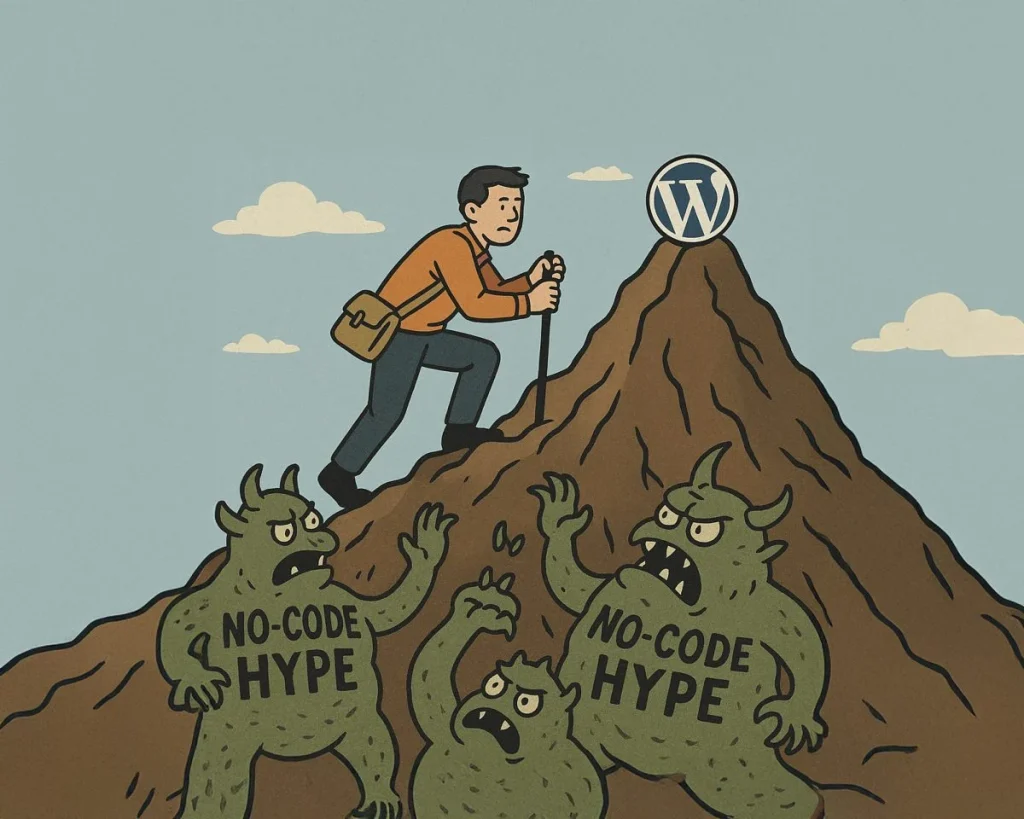
Many people think WordPress is just for blogs. They think it is old technology. But this is a mistake. While everyone was looking at flashy new “No-Code” tools, WordPress evolved. Today, it is not just a tool for writers. It is a powerful engine for building applications. It is the original Low-Code tool that enterprises actually use for the long run.
More Than Just a Place for Articles
To understand why big companies use WordPress, you have to stop thinking of it as a “Content Management System.” You should think of it as an “Application Framework.”
In the past, WordPress was simple. You had a title, and you had a body of text. That was it. But today, the software is much smarter. It can handle any kind of data you can imagine.
Think about a real estate company. They do not just have “posts.” They have “houses.” A house has a price, a location, a number of bedrooms, and a photo gallery. In a traditional software project, a developer would have to build a database from scratch to handle this. They would have to write complex code just to save a house to the database.
In WordPress, this is easy. You can create a “Custom Post Type” called “House.” You can add custom fields for the price and location. You can do this with a tiny bit of code, or even with a plugin that requires no code at all.
Suddenly, you have a professional system to manage thousands of real estate listings. You get a search engine, a user login system, and an easy way to edit data, all out of the box. You did not have to build the foundation. You just moved into a house that was already built. This is the power of a Low-Code framework. It solves the boring problems for you so you can focus on your business.
The No-Code Experience for Marketing Teams
For a long time, marketing teams hated waiting for developers. If they wanted to change a headline or move a button on the homepage, they had to send a ticket to the IT department. Then they had to wait for a week.
Modern WordPress solves this with a true No-Code experience. This is done through the “Block Editor.”
Imagine your website is made of Legos. Every paragraph, every image, every video, and every button is a separate Lego brick. In the new WordPress, you can drag these bricks around. You can stack them. You can change their colors.
This is perfect for big companies. A large enterprise can define their own “Brand Blocks.” For example, they can create a special “Product Card” block that always looks perfect. It has the right font and the right colors. A marketing manager can put this block on any page they want. They do not need to know HTML. They do not need to call a developer. They just drag and drop.
This allows the marketing team to move fast. They can build landing pages for new products in minutes. But because the blocks are pre-made by the design team, the website never looks messy. It is the perfect balance between freedom for the user and control for the brand.
The Low-Code Power of Hooks
There is a problem with most “No-Code” tools. They are great until you need to do something special.
Let’s say you are selling t-shirts. A simple No-Code store works fine. But then, your boss tells you a new rule. “If a customer buys more than 50 shirts, and they live in Mojokerto, we need to give them a special discount and send an email to the shipping manager.”
In a closed system like Shopify or Wix, this might be impossible. If the platform does not have a button for that rule, you are stuck. You hit a wall.
WordPress is different. It uses a system called “Hooks.” This is where the “Low-Code” magic happens.
Hooks are like little doors in the software. You can open a door and slip in a small piece of paper with instructions. For the example above, a developer can write ten lines of code. They hook into the “Checkout” process. The code says: “Check if the cart has 50 items. Check if the location is Mojokerto. If yes, apply discount.”
You do not have to rebuild the whole store. You do not have to hack the core software. You just add a tiny script on top. This ability to extend the software is why enterprises love it. It means the software can grow with the business. You will never hit a wall where the software says “I cannot do that.”
Owning Your House Instead of Renting It
The biggest risk for a modern company is “Vendor Lock-in.”
When you use a proprietary No-Code tool, you are renting. You are building your house on land that belongs to someone else. You pay a monthly fee. If that company decides to double the price next year, you have to pay. If that company decides they do not like your content, they can delete your account. If that company goes bankrupt, your application disappears.
WordPress is “Open Source.” This means you own it. It is free to download. Once you download it, it is yours forever.
You can host it anywhere. You can put it on Amazon Web Services. You can put it on Google Cloud. You can host it on a private server in your own office basement. No one can take it away from you. No one can tell you what you can or cannot publish.
For governments, banks, and universities, this is critical. They cannot risk their data being locked inside a startup’s server. They need total control. This is why you see WordPress used by the White House, NASA, and major news organizations. They are not using it because it is free. They are using it because it guarantees they own their digital future.
separating the Head from the Body
There is a new trend in technology called “Headless.” This sounds complicated, but it is actually simple.
In the old days, WordPress handled everything. It stored the data (the backend) and it showed the website to the visitor (the frontend).
In a Headless setup, you cut the connection. You use WordPress only for the backend. Your editors log in to WordPress. They write articles. They upload photos. They manage products. It is the easy interface they already know.
But the visitors do not see WordPress. Instead, the data is sent to a separate application. This application might be built with modern tools like React or Vue. It might be a mobile app on an iPhone.
This is the ultimate enterprise architecture. It gives you the best of both worlds. The non-technical staff gets an easy No-Code tool to manage content. The technical engineers get to build a super-fast, modern app using the latest code.
It transforms WordPress into a “Content Engine.” It sits quietly in the background, feeding data to apps, smartwatches, and websites all over the world.
The Benefit of Boring Technology
Engineers have a saying: “Choose Boring Technology.”
New tools are exciting, but they are risky. If you build your company on a brand new No-Code tool that launched six months ago, you have a problem. Who will fix it if it breaks? There are no experts yet.
WordPress is “boring” in the best way possible. It has been around for twenty years. It powers more than 40% of the entire internet.
This means finding help is easy. If you need a developer, there are thousands of them in every city. If you have a question, someone has already answered it on a forum. There are thousands of agencies that specialize in it.
If your lead developer quits, your company does not die. You can find a replacement in a week. If you use a niche tool that only 500 people in the world know how to use, hiring is a nightmare. Using popular, proven technology reduces risk. It is a safety net for the business.
Speed and Cost
Finally, let’s talk about money and time.
Building a custom application from zero is expensive. You have to build a user login system. You have to build a password recovery system. You have to build a media library to handle images. You have to worry about security and database connections.
This takes months. It costs hundreds of thousands of dollars.
When you use WordPress as a framework, all of that is already done. It is free and it works perfectly. You start the race halfway to the finish line.
This allows companies to move fast. They can launch a “Minimum Viable Product” (MVP) in weeks instead of months. They can test their business idea quickly. If it works, they can scale it up.
Because there is a massive library of plugins, you can add complex features instantly. Do you need to sell subscriptions? There is a plugin for that. Do you need to turn the site into a learning platform with quizzes? There is a plugin for that.
You are buying functionality for a few hundred dollars that would cost thousands of dollars to build yourself.
The Long Run
It is easy to get distracted by the shiny new things. The tech world loves to talk about the “next big thing.”
But when you look at the tools that actually survive, the list is short. WordPress has survived because it adapts. It is not just a blog script anymore. It is a chameleon.
For the marketing intern, it is a No-Code page builder.
For the software engineer, it is a Low-Code application framework.
For the CEO, it is a secure, owned asset that saves money.
Companies and enterprises do not need more experimental tools. They do not need to ride the rollercoaster of hype. They need stability. They need tools that will still be here in ten years.
WordPress is not the trendy choice. It is the smart choice. It is the tool you use when you are done playing with toys and are ready to build something that lasts.